
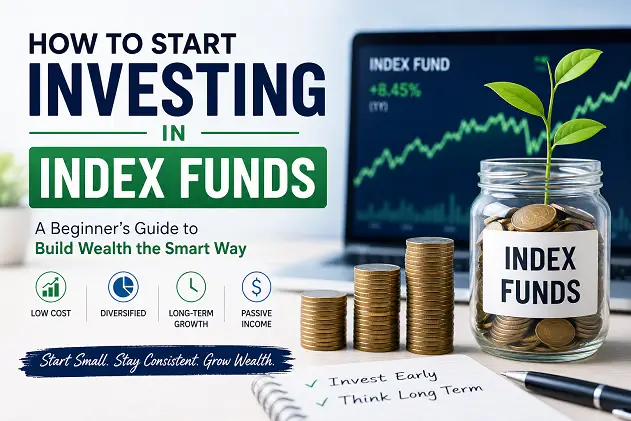
If you have ever wondered how ordinary people slowly build wealth without constantly trading stocks, the answer often comes down to one simple strategy: index fund investing. Over the last decade, millions of beginner investors have started using index funds because they are simple, affordable, and surprisingly effective for long-term financial growth.
The good news? You do not need to be rich, a finance expert, or a stock market genius to get started. In fact, many people begin investing with less than $100 and grow their portfolio over time through consistency and patience.
In this guide, you will teach me the basics of how to start investing in index funds in the easiest way possible. You will learn how index funds work, why investors love them, how to choose the right one, the risks involved, and how beginners can start investing confidently.
What Is an Index Fund?
An index fund is a type of investment fund designed to track the performance of a specific market index. Instead of trying to beat the market, it simply follows it.
For example, an S&P 500 index fund invests in the 500 largest companies in the United States. That means when you buy one share of the fund, you indirectly own small pieces of companies like Apple, Microsoft, Amazon, and hundreds of others.
This is one reason why index funds are considered a form of passive investing. The fund manager is not actively picking winning stocks every day. Instead, the fund automatically mirrors the companies inside a market index.
Think of it like buying an entire basket of stocks instead of trying to guess which single stock will succeed. That diversification helps reduce risk and makes investing much easier for beginners.
Today, index funds are available in many forms, including:
- Stock market index funds
- Bond index funds
- International index funds
- Sector-specific index funds
- ETFs (Exchange-Traded Funds)
Because of their simplicity and low cost, index funds have become one of the most popular investment options in the world.
How Do Index Funds Work?
Index funds work by copying the holdings of a market index. If the index contains 500 companies, the fund invests in those same companies in roughly the same proportions.
Here is a simple example.
Suppose the S&P 500 index allocates:
- 7% to Apple
- 6% to Microsoft
- 4% to Amazon
The index fund will follow similar allocations. As those companies grow or decline, the value of the fund changes as well.
This approach allows investors to benefit from the overall growth of the market over time instead of relying on a few individual stocks.
One major advantage is lower management costs. Since the fund is not actively managed every day, the expense ratio is usually very low compared to traditional mutual funds.
Over the long term, this can make a huge difference. Even saving 1% annually in fees can significantly increase your investment returns over decades.
Another important factor is compound growth. When your investments generate profits and those profits are reinvested, your money begins to grow on top of previous gains. Over time, this creates a snowball effect.
That is why many long-term investors prefer index funds for retirement planning and wealth building.
What to Know Before Investing in Index Funds
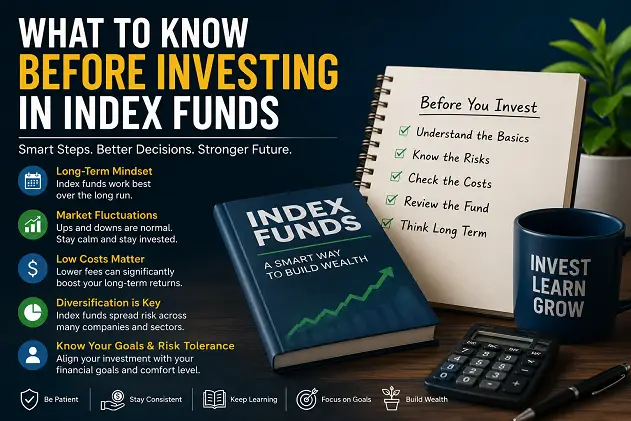
Before you invest your first dollar, there are several important things you should understand.
Index Funds Are Long-Term Investments
Index funds are not designed for quick profits. Markets rise and fall regularly, and short-term volatility is completely normal.
Successful investors usually stay invested for years or even decades. The longer your investment horizon, the more time compound growth has to work in your favor.
Read More: I’m 25 And Earning ₹30k a Month How Should I Start Investing for Long-Term Growth?
Market Drops Will Happen
Even the best index funds lose value during market crashes. However, historically, major markets have recovered over time.
This is why emotional investing can become dangerous. Panic-selling during downturns often hurts investors more than the crash itself.
Fees Matter More Than Most People Think
Every index fund charges a small fee called an expense ratio. While the difference may look tiny, lower fees usually mean better long-term returns.
For example:
- A 0.03% fee is extremely low
- A 1% fee is considered expensive for an index fund
Always compare fees before investing.
Diversification Reduces Risk
One of the biggest strengths of index funds is diversification. Instead of depending on one company, your money spreads across many businesses and industries.
If one company performs poorly, others may balance the losses.
Your Risk Tolerance Matters
Some investors are comfortable with market swings, while others panic during downturns.
Understanding your personal risk tolerance helps you choose the right mix of investments.
If you are young and investing for retirement, you may accept more stock exposure. If you need money soon, safer investments might be better.
Why Do Investors Use Index Funds?
There is a reason legendary investors like Warren Buffett often recommend index funds to ordinary people.
They combine simplicity, diversification, affordability, and strong long-term performance.
Lower Costs
Actively managed funds often charge high fees because professionals constantly buy and sell stocks.
Index funds, however, follow a passive strategy, so operating costs stay lower.
Better Long-Term Performance
Interestingly, many actively managed funds fail to outperform the market over long periods.
Index funds simply match the market, which historically has delivered strong long-term returns.
Easy for Beginners
You do not need advanced financial knowledge to invest in index funds. Once you understand the basics, the process becomes straightforward.
Diversification
Buying a single stock can be risky. Buying an index fund gives you exposure to dozens, hundreds, or even thousands of companies instantly.
Reduced Emotional Trading
Because index funds encourage long-term investing, investors are less likely to panic and make impulsive decisions.
That disciplined approach often leads to better results over time.
Who Can Invest in Index Funds?
Almost anyone can invest in index funds.
You do not need:
- A finance degree
- Large savings
- Trading experience
- Stock-picking skills
Students, working professionals, freelancers, retirees, and even teenagers can start investing with small amounts.
Many platforms now allow fractional investing, meaning you can buy portions of expensive funds with very little money.
This accessibility has completely changed modern investing.
In fact, one of the smartest financial habits young adults can build is learning to invest early. Starting sooner gives compound growth more time to work.
Even investing small amounts consistently can become surprisingly powerful over decades.
How Can You Invest in Index Funds?
There are several ways to invest in index funds today.
Through Brokerage Accounts
Online brokers allow you to buy index funds directly from the stock market.
Popular brokerages usually offer:
- Low fees
- Easy account setup
- Mobile apps
- Automated investing tools
Through Retirement Accounts
Many people invest in index funds through retirement accounts such as:
- 401(k)
- IRA
- Roth IRA
These accounts may also offer tax advantages depending on your country.
Through ETFs
ETFs, or Exchange-Traded Funds, are a popular type of index fund traded like stocks.
They are flexible, liquid, and beginner-friendly.
Through Robo-Advisors
Robo-advisors automatically create and manage diversified portfolios for investors.
These platforms are ideal for beginners who want a hands-off investing experience.
How to Invest and Select the Right Index Fund
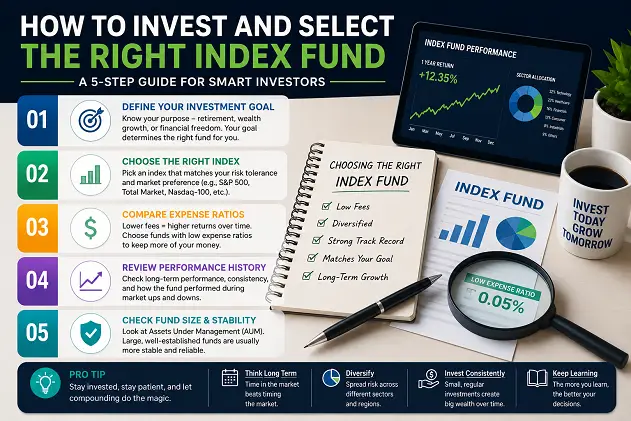
Choosing the right index fund may feel overwhelming at first, but the process becomes much easier when broken into steps.
Read More: 4G 5G Data Sell: The Complete Guide to Earning Money From Your Unused Mobile Data
Step 1: Define Your Investment Goal
Ask yourself:
- Are you investing for retirement?
- Building long-term wealth?
- Saving for a house?
- Creating passive income?
Your goal influences the type of index fund you should choose.
Step 2: Choose the Market Index
Different funds track different indexes.
Popular examples include:
- S&P 500
- Nasdaq-100
- Total Stock Market
- International Markets
Beginners often start with broad-market index funds because they offer strong diversification.
Step 3: Compare Expense Ratios
Lower costs generally mean higher net returns over time.
Always compare management fees before investing.
Even small differences become significant over decades.
Step 4: Review Historical Performance
Past performance never guarantees future results, but it still helps you understand how a fund behaves during different market conditions.
Look at:
- Long-term returns
- Volatility
- Fund stability
Step 5: Check Assets Under Management (AUM)
Larger funds usually have:
- Better liquidity
- Lower operating costs
- Greater stability
Well-established index funds are often safer choices for beginners.
If you want to teach me the basics of how to start investing in index funds, understanding these five steps is essential.
Index Funds vs Individual Stocks: A Simple Comparison
| Feature | Index Funds | Individual Stocks |
|---|---|---|
| Risk Level | Lower | Higher |
| Diversification | High | Low |
| Management Style | Passive | Active |
| Beginner Friendly | Yes | Often difficult |
| Potential Volatility | Moderate | High |
| Research Needed | Minimal | Extensive |
| Long-Term Stability | Strong | Uncertain |
| Investment Cost | Usually low | Varies |
This table clearly shows why beginners often prefer index funds over individual stock picking.
How to Start Investing in Index Funds as a Beginner
Starting your investing journey does not need to be complicated.
Here is a simple beginner roadmap.
Start Small
You do not need thousands of dollars. Even small monthly investments matter.
Consistency is more important than starting with a huge amount.
Open a Brokerage Account
Choose a reliable investing platform with:
- Low fees
- User-friendly interface
- Good customer support
- Access to index funds and ETFs
Pick One Broad Index Fund
Many beginners make the mistake of overcomplicating investing.
Starting with one diversified index fund is often enough.
Automate Your Investments
Automatic monthly investing builds discipline and removes emotional decision-making.
This strategy is called dollar-cost averaging.
Stay Invested Long-Term
The stock market will fluctuate. That is normal.
Long-term investors succeed because they remain patient during temporary downturns.
If your goal is to teach me the basics of how to start investing in index funds, patience is one of the most important lessons.
Risks of Index Fund Investing
Although index funds are considered relatively safe compared to individual stocks, they still carry risks.
Market Risk
If the overall market declines, index funds decline too.
There is no protection from broad market crashes.
Limited Flexibility
Index funds follow an index automatically. They cannot quickly react to changing market conditions.
Average Returns
Index funds aim to match the market, not outperform it.
That means you probably will not see massive short-term gains.
Sector Concentration
Some indexes become heavily weighted toward certain industries.
For example, technology companies dominate many major U.S. indexes today.
Emotional Investing
Ironically, the biggest risk is often investor behavior.
People panic during market crashes and sell investments at the worst possible time.
Long-term discipline matters more than market timing.
Assets Under Management (AUM) & Fund Manager Explained
When researching index funds, you will often see terms like AUM and fund manager.
What Is Assets Under Management (AUM)?
AUM refers to the total market value of assets managed by a fund.
For example:
- A fund with $500 billion AUM is extremely large
- A fund with $5 million AUM is relatively small
Larger funds often provide:
- Better liquidity
- Lower fees
- More investor confidence
What Does a Fund Manager Do?
Even though index funds are passively managed, fund managers still oversee:
- Fund operations
- Rebalancing
- Tracking accuracy
- Administrative processes
Their job is to ensure the fund closely follows the target index.
Experienced fund management companies usually inspire greater investor trust.
Which Platform Is Best for Investing in Index Funds?
The best platform depends on your goals, country, and investing style.
However, beginners should look for these features:
Low Fees
High fees reduce long-term returns.
Choose platforms with competitive pricing and low commission costs.
Easy-to-Use Interface
A beginner-friendly dashboard makes investing less intimidating.
Educational Resources
Some platforms provide tutorials, calculators, and portfolio guidance.
These tools can help new investors learn faster.
Automatic Investing Options
Automation simplifies long-term investing and encourages consistency.
Strong Reputation
Always choose trusted and regulated platforms with good customer reviews.
Popular investment platforms globally include:
- Vanguard
- Fidelity
- Charles Schwab
- BlackRock iShares
- TD Ameritrade
Before choosing a platform, compare:
- Fees
- Fund selection
- Minimum investment requirements
- Account types
- Customer support
Conclusion
Index fund investing has completely changed the way ordinary people build wealth. Instead of spending endless hours researching stocks, beginners can now invest in diversified portfolios with minimal effort and lower costs.
The beauty of index funds lies in their simplicity. You do not need to predict the market, chase trends, or become a financial expert overnight. By investing consistently, keeping fees low, and staying patient, you give yourself a strong chance to grow wealth over time.
If you truly want to teach me the basics of how to start investing in index funds, remember this simple idea: start early, invest consistently, and think long term.
The sooner you begin, the more powerful compound growth becomes.
FAQs About Index Fund Investing
Are index funds safe for beginners?
Index funds are generally considered safer than individual stocks because they provide diversification across many companies. However, they still carry market risk.
How much money do I need to start investing in index funds?
Many platforms allow beginners to start with as little as $10 to $100 through fractional investing.
Can I lose money in index funds?
Yes. Index funds can lose value during market downturns. However, long-term investors historically have seen markets recover over time.
What is the difference between ETFs and index funds?
ETFs trade like stocks throughout the day, while traditional index mutual funds are priced once daily. Both can track the same indexes.
Are index funds good for long-term investing?
Yes. Index funds are widely used for retirement planning and long-term wealth building because of diversification, low costs, and historical market growth.
How do index funds make money?
Index funds grow in value when the underlying companies increase in price. Investors may also earn dividends from the companies inside the fund.
Should beginners invest in multiple index funds?
Many beginners start with one broad-market index fund. As experience grows, investors may add international or bond index funds for further diversification.
